Position-Triggered vs Time-Triggered Acquisition: Synchronising a Stage With a Camera or Instrument
A camera can return exactly the expected number of images while sampling the wrong locations. An instrument can report a measurement that belongs to the previous position. Both failures come from the same place: the link between motion and acquisition was assumed rather than specified. Two engineering guides from positioningstages.com address this, one on position-triggered versus time-triggered image acquisition and one on synchronising stage motion with an external measurement instrument. This article brings their recommendations together.
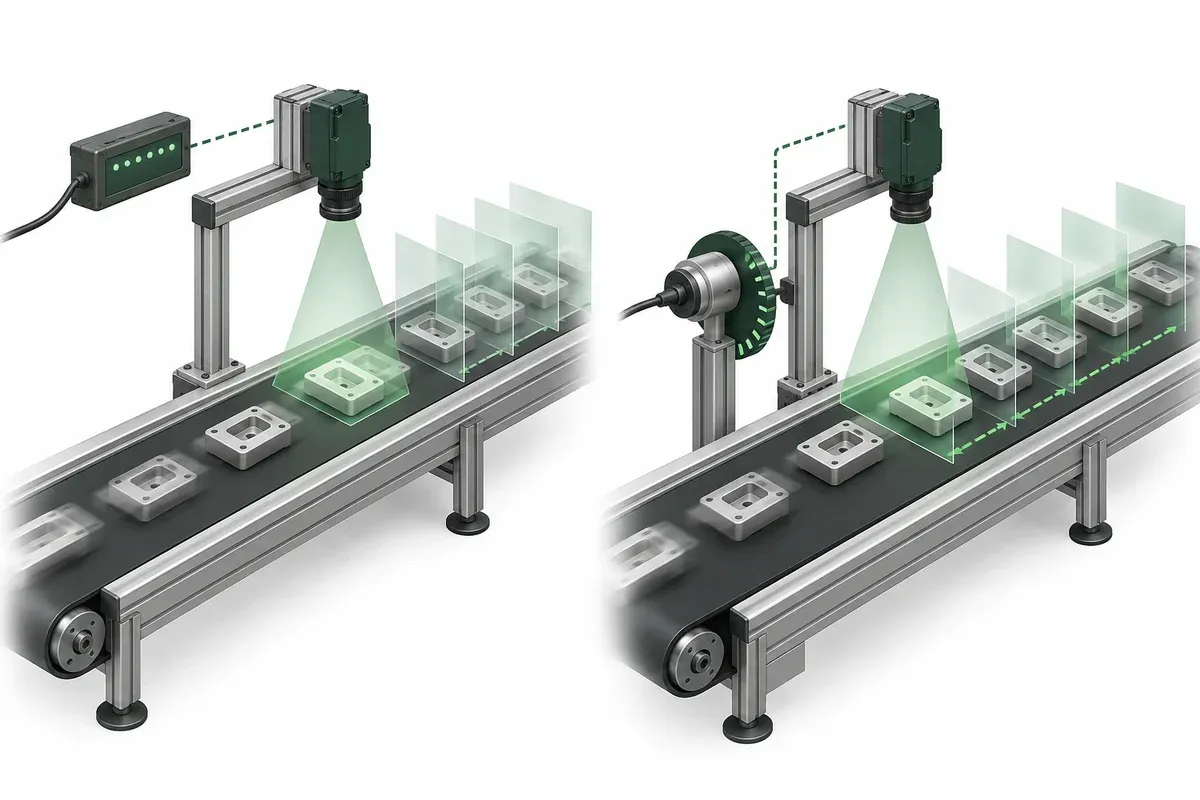
AI-generated concept illustration comparing position-triggered and time-triggered image acquisition on a moving stage. Image: positioningstages.com.
Choose the sampling variable first
Time-triggered acquisition is organised around a clock. Position-triggered acquisition is organised around a spatial condition or interval. A third option is to acquire only after a verified stationary state. The right choice depends on the measurement question, motion behaviour and available hardware, and neither label on its own establishes exposure accuracy or camera-controller compatibility.
Write the desired sample locations before selecting a trigger mechanism. If the specimen needs regularly spaced images, specify the spatial coverage and permissible location uncertainty. If a time-dependent process is being observed, explain why time itself is the primary variable. The guide cites a third-party trigger system as an example of distinct time and distance trigger types, and is clear that this does not mean such functions are supplied with positioningstages.com products.
Trace each event through the camera
Separate the event source, the electrical signal, camera acceptance, the exposure interval and image delivery. Each transition can affect how the image should be interpreted. Ask the camera provider for its supported trigger modes and timing definitions, and ask the integrator to confirm the complete interface.
Do not assume a connector establishes voltage compatibility, polarity or an approved wiring arrangement; request model-specific documentation rather than guessing signal levels or pin assignments. Define what happens when the camera is busy and cannot accept another event.
For a moving specimen, exposure covers an interval, not a point. Decide how the image's representative position will be assigned and whether motion during exposure matters, a question that remains even when triggers fire at precisely defined positions. The related article on calculating and calibrating field of view for stage motion helps translate image spacing into stage moves.
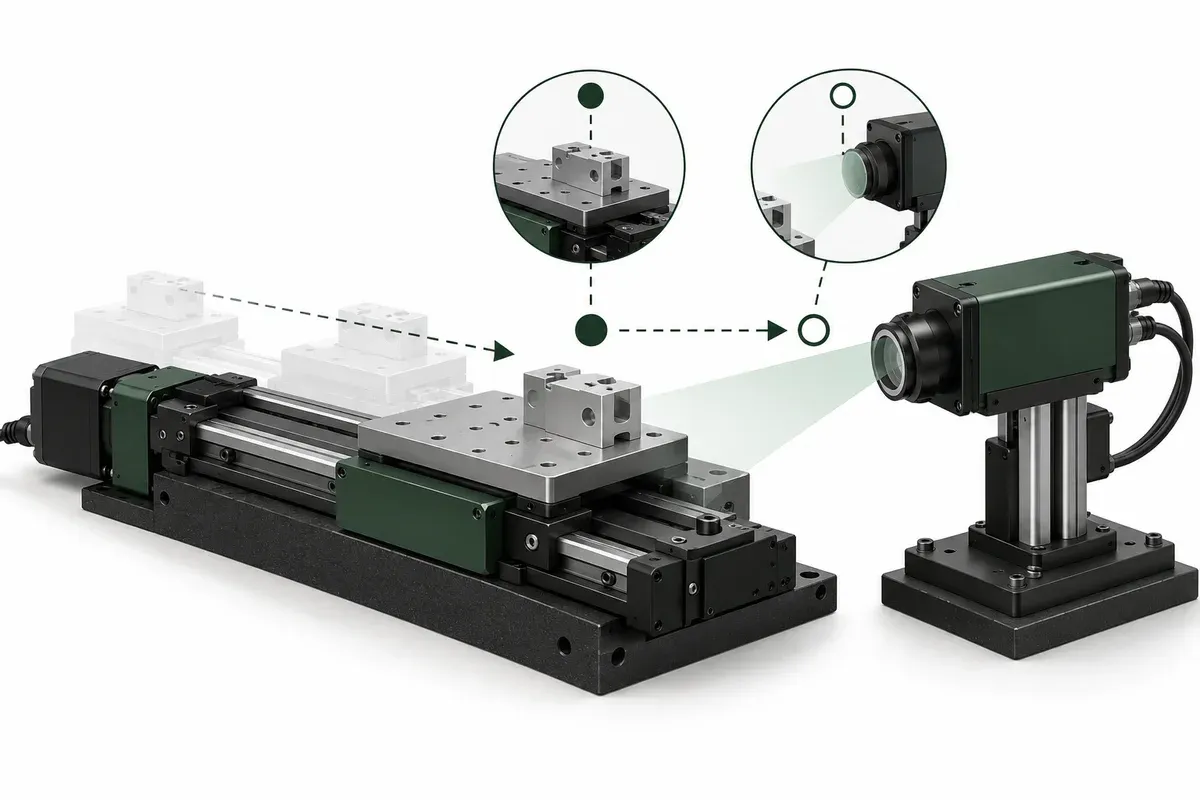
AI-generated concept illustration of a positioning stage synchronised with an external measurement instrument. Image: positioningstages.com.
Treat stage plus instrument as a small distributed system
Connecting an axis to a measurement instrument creates a system with more than one owner of state. The synchronisation guide makes three points:
- Motion completion and instrument readiness are separate conditions. Neither should be inferred from the other.
- Every trigger request must be associated with the resulting measurement. Give each acquisition a unique identifier linked to the motion operation that preceded it.
- Timeouts and duplicate events must be handled by design. Decide before commissioning what happens when the instrument does not answer, answers twice or answers late.
Use each manufacturer's own definitions for ready, busy and complete states rather than picking a convenient signal and giving it a stronger meaning. Separate latency from uncertainty in latency: a known fixed delay may be compensated in some designs, while variable timing needs a different approach. A host-software timestamp is not necessarily the instant the physical measurement happened.
A synchronisation checklist
- Identify the owner and meaning of every readiness and completion state.
- Obtain approved physical interface and communication documentation.
- State the required timing relationship to position or motion readiness.
- Link each acquisition to its motion operation with a unique identifier.
- Define instrument timeout, retry and duplicate-event behaviour.
- Test the whole association chain, not individual signals in isolation.
Verify registration and completeness together
Counting images is not verification. A good test checks that every expected sample exists, that none is duplicated and that each is registered to the correct position. Using a specimen with known features at known locations makes misregistration visible. Run the test at production speed and payload, include scan starts, stops and direction changes, and deliberately interrupt acquisition once to see how missing data is flagged. A test that only covers the smooth middle of a scan at a gentle speed will pass systems that later fail in production, because most registration errors appear at transitions rather than in steady motion. Combine this with the settling rules in the guide on choosing move-and-settle or continuous-scan operation, and keep a log of commands, status and errors as described in logging commands, status and errors for a reproducible motion test.
Stages for imaging fixtures can be shortlisted with the stage selector. Trigger and interface requirements can be sent through request a quote or to sales@positioningstages.com; the team will confirm which interfaces a given configuration actually supports rather than assuming them. Bring the camera model, trigger source and required sample spacing to that conversation.
FAQ
When should I use position-triggered acquisition?
When the measurement needs samples at defined spatial locations or spacing, especially if speed may vary during the move.
When is time-triggered acquisition appropriate?
When the process being observed is time-dependent and elapsed time is the primary variable of interest.
Does a matching connector mean a camera and controller are compatible?
No. Voltage, polarity, timing definitions and approved wiring must come from model-specific documentation.
How do I know each measurement matches the right position?
Give each acquisition a unique identifier linked to the motion operation, and verify registration with a specimen that has known features.
Contact positioningstages.com: email sales@positioningstages.com · positioningstages.com